
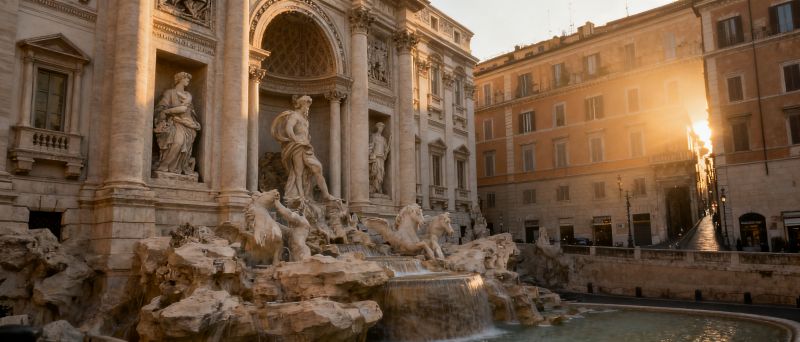
he coin toss into the Trevi Fountain is a ritual performed by thousands daily, but the fountain itself sits in a piazza that has been a crossroads of Roman life for centuries. What most visitors miss is that the Trevi district—yes, the entire rione—takes its name from this aquatic monument, and its streets hold layers of history that predate the Baroque spectacle by a millennium. I lived two blocks from the fountain for a year。and the morning light hitting the travertine before the crowds arrive is a different world entirely.The fountain's water comes from the Aqua Virgo, an aqueduct completed in 19 BC by Marcus Agrippa. That's not trivia;it's the reason the Trevi exists. When the aqueduct was restored in the 15th century, Pope Nicholas V built a simple basin here to announce the return of reliable water to the area. The current elaborate facade—designed by Nicola Salvi in 1732 and completed by Giuseppe Pannini in 1762—was a political statement as much as an artistic one。showcasing papal power through hydraulic engineering. Stand on the steps of the nearby church of Santi Vincenzo e Anastasio and you'll notice the fountain's central niche aligns perfectly with the ancient Via Lata, a Roman road that still runs beneath the modern street grid.Walk fifty meters in any direction from the fountain and the Trevi's character shifts. To the west, narrow alleys lead to the Quirinal Hill, where the presidential palace sits;
to the east, the streets toward the Pantheon are lined with workshops that have been in the same families for generations. A key maker on Via della Panetteria once showed me a 19th-century key he claimed opened a door in the Trevi's basement—the fountain has a lower level accessible only to maintenance crews. That kind of story is typical of the district: history isn't behind glass here;it's in casual conversation. The area's population has dropped from about 5,000 in the 1950s to under 1。500 today, mostly due to short-term rentals, and that changes the rhythm of daily life. The bakery that opened at 5 a.m. for locals now opens at 7 a.m. for tourists.
Trevi's food scene tells a similar story of adaptation. The famous gelateria near the fountain?Overpriced and not worth the queue. But two blocks away, on Via della Stamperia。there's a tiny forno that sells pizza bianca by weight—a Roman staple—and the owner still calls his regulars by name. I once watched him refuse service to a group of tourists who asked for pineapple on their pizza, not out of rudeness but because he genuinely didn't understand the request. That authenticity is fragile. The Trevi district's identity hangs between its monumental centerpiece and the everyday life that persists in its side streets, and the balance is shifting.What makes Trevi worth more than a photo stop is its layered identity: an ancient water source。a papal showpiece, and a living neighborhood. The fountain will always draw crowds, but the district rewards those who look past the water and the coins. Walk up Via Poli to the Quirinal, or down to the Vicolo Scavolino, and you'll find Rome as it actually lives—unpolished, argumentative, and deeply human. The Trevi isn't just a monument;it's a place where history and contemporary life collide daily, and that collision is what I'd recommend experiencing, even if it means skipping the coin toss.